
Leases & Planning8 min read
Leasehold Improvements in Canada: CCA Class 13, Depreciation & Who Pays (Clinic Owner's Guide)
Leasehold improvements a tenant pays for are generally CCA Class 13 in Canada. Class 13 has no percentage rate: the cost is written off straight-line over the remaining lease term plus the first renewal option, never faster than 5 years and never slower than 40. For a clinic owner, that makes the lease term part of the tax plan.
Key takeaway. Your fit-out is depreciated over the lease, not at a fixed rate. Each year's spending is written off at the lesser of one-fifth of its cost or its cost spread over the 12-month periods left in the lease (first renewal included, capped at 40). A longer lease means a smaller annual deduction. A landlord allowance can be taxed as income or, by election, used to reduce the cost you depreciate. This guide explains the rules. It is not tax advice, so confirm your numbers with your accountant.
What Counts as a Leasehold Improvement
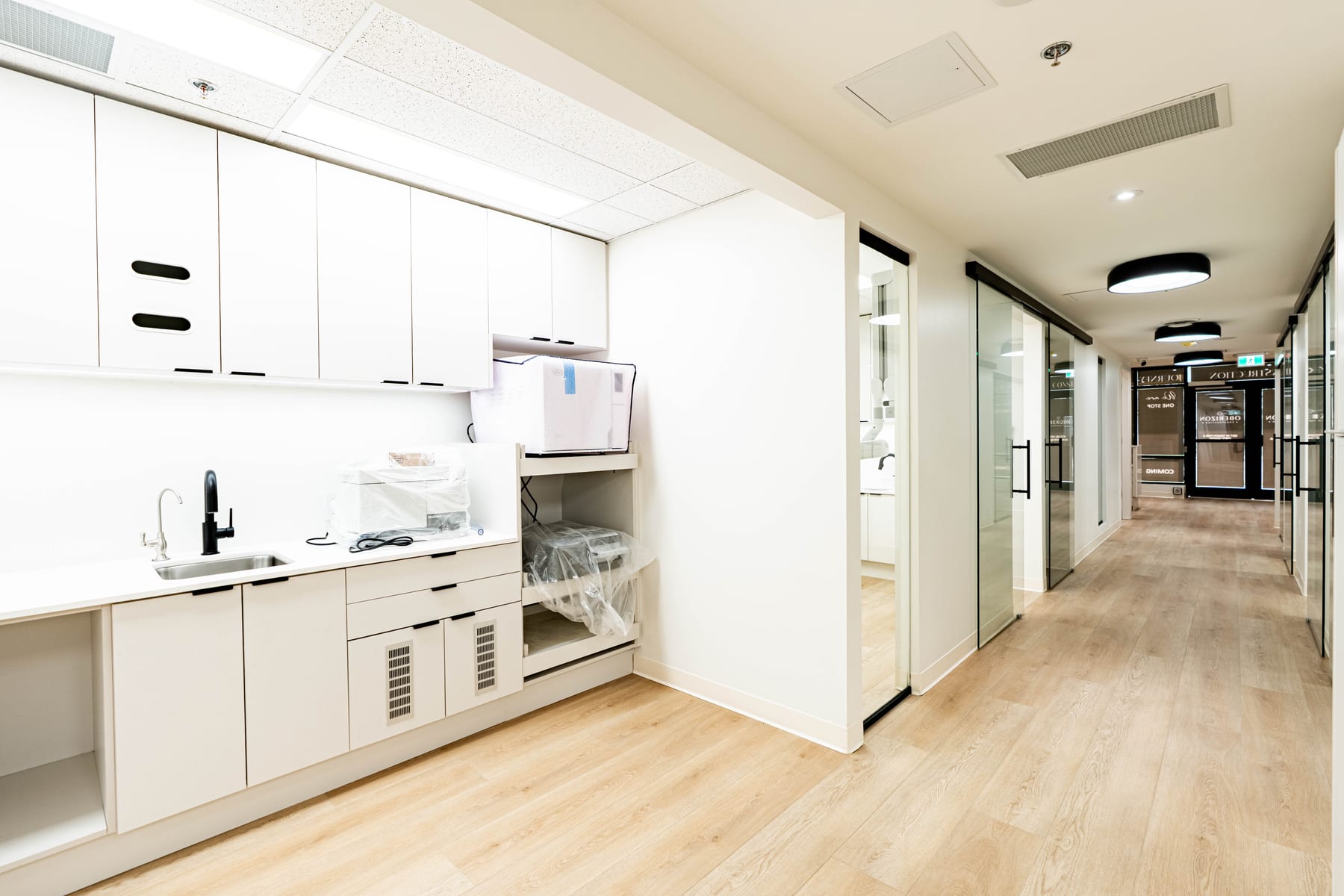
A leasehold improvement is a capital cost a tenant pays to improve space it does not own: partition walls, ceilings, flooring, millwork, plumbing rough-in for operatories, electrical and data, HVAC changes. The CRA's Income Tax Folio S3-F4-C1 says leasehold improvement costs are generally included in Class 13, and that the tenant has to have actually incurred the cost to claim anything.
Three things usually sit outside Class 13 on a clinic project:
- Equipment that leaves with you. Dental chairs, sterilizers, furniture and similar items belong to the practice and have their own classes. The CRA's classes of depreciable property page puts furniture, some fixtures and business equipment not in another class in Class 8 at 20%.
- Work the landlord pays for and owns. If the landlord funds and owns the work, it is not your capital cost. How the landlord treats it is the landlord's question.
- Building-scale work. The Folio notes that a building or structure a tenant erects on leased land can fall into a building class instead. If your scope goes beyond an interior fit-out, ask your accountant which class applies before you assume Class 13.
The practical step is to ask your contractor for a cost breakdown that separates the fit-out from equipment supply and installation. That one document makes the class split much easier for whoever prepares your return.
How the Class 13 Write-Off Is Calculated
The rule lives in Schedule III of the Income Tax Regulations, and it works differently from the declining-balance classes most owners know.
Each year's spending is its own layer. Money spent on the fit-out in one tax year is tracked separately from money spent on a later renovation in the same space.
The annual limit for each layer is the lesser of two amounts:
- one-fifth of that layer's cost, or
- that layer's cost divided by the number of 12-month periods from the beginning of the tax year it was spent in to the day the lease ends, counting no more than 40 periods.
The first renewal counts. If the lease gives you a right to renew, Schedule III treats the lease as ending on the last day of the first renewal term. Only that first renewal is added, however many options the lease contains.
The two bounds follow from the formula. The one-fifth cap means you can never write a layer off faster than 5 years, even on a 3-year lease. The 40-period cap means you never stretch it beyond 40 years, even on a very long ground lease.
The count starts at the beginning of your tax year, not the lease start date. If your fiscal year begins before the lease does, your accountant's period count may differ slightly from a simple reading of the lease.
The CRA's T2 Corporation Income Tax Guide confirms that Class 13 uses the straight-line method. The older half-year rule applies only to property acquired before November 21, 2018.
Worked Example: Lease Term vs Annual Write-Off
Assume a clinic tenant spends $200,000 on leasehold improvements in the first tax year of the lease, and the lease starts on the first day of that tax year. The table shows the full-year Class 13 limit before any first-year incentive.
| Lease as signed | 12-month periods counted | Annual Class 13 limit | Years to write off |
|---|---|---|---|
| 3 years, no renewal option | 3, but the one-fifth cap applies | $40,000 | 5 |
| 5 years, no renewal option | 5 | $40,000 | 5 |
| 5 years plus one 5-year renewal option | 10 | $20,000 | 10 |
| 10 years, no renewal option | 10 | $20,000 | 10 |
| 10 years plus two 5-year renewal options | 15 (first renewal only) | $13,333 | 15 |
| 25 years plus a 20-year renewal option | 45, capped at 40 | $5,000 | 40 |
Three things stand out for clinic tenants:
- A renewal option slows the write-off. On the same $200,000, adding a 5-year renewal option to a 5-year lease halves the annual deduction. That is not a reason to give up renewal rights, which protect a fit-out you cannot move. It is a reason to know the cash-flow effect before you sign.
- Short leases do not speed things up. Below 5 years, the one-fifth cap governs.
- A second renovation starts a new layer. If you add two operatories in year 6, that cost is spread over the periods remaining from year 6, including the first renewal if that is still ahead of you.
These figures are illustrations of the formula, not a projection for your practice. Your accountant will apply the actual dates, the first-year rules below and any inducement election.
The First Year and the Investment Incentives
Before November 21, 2018, Class 13 had an equivalent of the half-year rule: the CRA's archived bulletin IT-464R describes the first-year claim as limited to half the Schedule III amount.
That restriction has been suspended for most spending since then. The CRA's T2 guide states that the Accelerated Investment Incentive applies to Class 13 for property acquired after November 20, 2018 and before 2025. It also states that the Reaccelerated Investment Incentive applies to Class 13 for property acquired after 2024 that becomes available for use before 2034. Both suspend the half-year rule and its Class 13 equivalent.
The exact first-year amount depends on when the work was acquired and when it became available for use. The CRA's Accelerated Investment Incentive page sets out the general mechanics. Your accountant should confirm the factor that applies to your project. Construction schedules matter here, because a fit-out that finishes just after a fiscal year end can move the first claim into the next year.
Who Pays, and What a Landlord Allowance Does to Your Taxes
Who pays for the work decides who claims it.
| Who pays | Who owns the cost for tax | What happens on the tenant's return |
|---|---|---|
| Tenant pays the full fit-out | Tenant | Class 13 on the full cost |
| Landlord does and pays for the work directly | Landlord | Nothing to claim for that work |
| Landlord pays the tenant an allowance, tenant builds | Tenant | Allowance taxed as income, or cost reduced by election |
| Rent-free period instead of cash | Tenant, for any work it pays | Lower rent expense, no inducement payment |
The third row is the one that catches clinic owners. Under paragraph 12(1)(x) of the Income Tax Act, an inducement, reimbursement or allowance received in respect of the cost of property is generally included in income. Subsection 13(7.4) gives an alternative: the tenant can elect to reduce the capital cost of the improvements by up to the amount received. The improvements must have been acquired in the year, in the three preceding years or in the following year. The election is due by the tax return filing date.
The choice is a timing trade-off. Taking the allowance into income means tax now and a larger Class 13 cost to depreciate later. Electing means no income inclusion now and a smaller cost base. On a long lease, where Class 13 recovers the cost slowly, the election is often the more attractive option. That is a judgement for your accountant, made with your actual numbers.
How the allowance itself is negotiated, and what it usually covers, is a separate subject. Our tenant improvement allowance guide covers that side.
What This Means When You Plan the Build
The tax rules do not change what a clinic needs, but they do change how the cost lands. A few planning habits help:
- Get the lease terms to your accountant before you sign. The term and the first renewal set the write-off period.
- Ask for a cost breakdown, not just a total. Separating fit-out, equipment and soft costs gives your accountant what they need to classify the spending.
- Know your fiscal year end relative to substantial completion. It affects which year the first claim lands in.
- Keep the allowance paperwork. The amount, the date received and the work it relates to all feed the 13(7.4) election.
For a dental fit-out specifically, our dental office renovation team can set out the scope in a way that maps cleanly to those categories. For a broader clinic project, start with our healthcare construction page.
Conclusion
Leasehold improvements are generally Class 13, and Class 13 follows the lease. Each year's spending is written off straight-line over the remaining term plus the first renewal, between 5 and 40 years, with the half-year rule currently suspended for most new spending under the investment incentives. A landlord allowance is generally income unless you elect to reduce the cost of the improvements instead. None of this replaces your accountant's advice, but knowing the mechanics before you sign the lease means the term, the allowance and the build schedule can be set with the tax result in view.
Frequently asked questions
What CCA class are leasehold improvements in Canada?
Leasehold improvements a tenant pays for are generally Class 13 property. Class 13 has no fixed percentage rate. Under Schedule III of the Income Tax Regulations, each year's cost is written off straight-line over the remaining lease term plus the first renewal period, with a minimum of 5 years and a maximum of 40.
How is the Class 13 CCA calculated?
For each year's leasehold spending, the annual limit is the lesser of one-fifth of that cost and the cost divided by the number of 12-month periods from the start of the tax year in which it was spent to the end of the lease, counting the first renewal term and capped at 40 periods. A $200,000 fit-out on a 10-year lease with no renewal option works out to $20,000 a year.
Does the half-year rule apply to leasehold improvements?
Not for most current spending. The CRA's T2 guide says Class 13 uses the straight-line method with the half-year rule for property acquired before November 21, 2018. The Accelerated Investment Incentive and the newer Reaccelerated Investment Incentive suspend the equivalent rule for Class 13, the latter for property acquired after 2024 that becomes available for use before 2034.
Is a landlord's tenant improvement allowance taxable to the tenant?
It can be. Paragraph 12(1)(x) of the Income Tax Act generally includes an inducement or reimbursement tied to the cost of property in the recipient's income. Subsection 13(7.4) lets the tenant elect instead to reduce the capital cost of the improvements by up to the amount received, which means less income now and less CCA later. The election is due by the tax return filing date for the year.
Is dental or medical equipment a leasehold improvement?
Generally no. Equipment that belongs to the practice and leaves with it at the end of the lease, such as chairs, sterilizers and furniture, is usually depreciable in its own class rather than Class 13. The CRA lists furniture, fixtures and business equipment not in another class under Class 8 at 20%. The split between the two is worth agreeing with your accountant from the contractor's cost breakdown.
The service this article is about
Healthcare projects managed around compliance, equipment, service locations, patient flow, and operational readiness.
Healthcare Construction →Related reading
Planning a build like this?
Before you commit to a space, drawings, a budget, or a construction timeline, book a consultation and we will tell you what has to be planned before construction starts.