
Permits & Compliance8 min read
Building in Abbotsford or Chilliwack: What Changes in the Fraser Valley
Businesses keep moving east, and the assumption that comes with the move is that everything gets simpler out here. Cheaper trades, easier parking, smaller city hall. Two of those three are broadly true. The third is not, and it is the one that costs schedule.
Abbotsford and Chilliwack both treat a tenant improvement as its own thing rather than as a subset of a general commercial permit — and they do it differently from each other.
Key takeaway. Both Fraser Valley cities run tenant improvements as a distinct permit category, so a package assembled for a general commercial application lands in the wrong queue. Chilliwack is one of the only municipalities in the region that publishes a commercial review window — 6 to 8 weeks at best, past 12 in busy periods — which means the permit can be scheduled rather than guessed at.
Why the Commercial Market Keeps Moving East
The pull is not complicated. Lease rates are lower, the residential growth in Promontory, Garrison, Auguston and along the Clearbrook and McMillan corridors has pulled service demand with it, and there is parking — which sounds trivial until you have tried to run a clinic in a building where patients circle for fifteen minutes.
For healthcare specifically, the draw is population rather than price. Clinic and pharmacy demand out here tracks residential growth closely, and the professional tenancy concentrates near Abbotsford Regional Hospital and along the main arterials in a way that is legible from a map. A practice that has outgrown a Surrey unit often finds its next catchment is east rather than west.
What surprises people is the building stock. Both cities split sharply between mid-century downtown commercial and recent suburban construction, with very little in between. That matters more than the lease rate, because what the base building will support decides your fit-out cost far more than the rent does.
Abbotsford: a Tenant Improvement Is Its Own Permit
Abbotsford runs its permits through Planning and Development Services, and it treats a Tenant Improvement Permit as a distinct application type rather than folding the work into a general commercial application alongside new builds and complex projects.
The practical consequence is procedural rather than technical. The trade work is the same work it would be in Surrey. The submission route is not, and a package assembled to the wrong route comes back — which means the delay you experience is the resubmission, not the review.
Abbotsford also publishes its building permit wait times separately from its application pages. That is a small thing with a real use: it means the current window is checkable at the point of application rather than assumed from whatever a previous job took. We check it every time rather than quoting a figure from memory, and so should anyone pricing your schedule.
Chilliwack: the Second City Here That Publishes a Review Window
Most municipalities in the Lower Mainland publish their requirements and say nothing about how long review takes. Surrey is the well-known exception. Chilliwack is the other one, and it gets far less credit for it.
The city states that a building permit for a new commercial, industrial, institutional or multi-family residential project "can range from a minimum of 6 - 8 weeks to process, to upwards of more than 12 weeks from the date an application has been submitted", and is explicit that the figure moves with market conditions and development demand. It asks that current timing be confirmed with the Building Department rather than taken from the page.
That is genuinely useful. A published range, even a wide one with a caveat attached, lets you put the permit in the schedule as a number with a low and a high rather than as an unknown sitting in front of your opening date.
Chilliwack also runs Tenant Improvement permits as their own category, and it triggers one on a change of occupancy type even where nothing physical is being altered. An office becoming a clinic is an application in its own right. Two further requirements catch incoming tenants regularly:
- A letter of authorization from the building owner has to accompany the drawings. A signed lease does not substitute for it, and this is the most common reason a first submission is incomplete.
- A parking reconciliation based on the new use is required where the change of use affects the site's parking demand. This one can change whether the use works at that address at all, which is a reason to raise it before the lease rather than after.
What the Two Cities Do Not Share
It is tempting to treat the valley as one market with one process. It is not.
Abbotsford's tenant improvement route is a separate application type but the city does not commit to a review window on the application page. Chilliwack publishes a window for its commercial stream and asks for owner authorization and a parking reconciliation up front. They are two municipalities with two building departments, two sets of paperwork and two queues.
The mistake we see most often is a tenant who has done one project in Abbotsford assuming the second one in Chilliwack will run the same way. It will not, and the version of that mistake that costs money is discovering it after the drawings are packaged.
What Costs Less Out Here, and What Does Not
Lower: trade rates run below Metro Vancouver, and site access is genuinely easier. Most Fraser Valley commercial sites have surface parking, room to stage material and no elevator booking, which removes the access premium that pushes downtown Vancouver work to the top of our band. Lease rates are lower, which is usually what started the conversation.
The same: the construction itself. Our published per-square-foot ranges do not vary by city, and we will not invent a discount for a postcode. A dental operatory costs what a dental operatory costs.
Higher: travel, on the contractor's side. Chilliwack is the longest run we make from the White Rock office. We price that in from the start rather than letting it surface later as a change order, and you should expect any honest contractor to tell you the same thing rather than pretending the drive is free.
Unpredictable: the base building. Mid-century downtown stock in either city can surface undersized electrical service, drainage at the end of its life and mechanical that will not carry an extra tenant. That is the line the contingency exists for, and it is the single biggest variable between two units that look identical on a floor plan.
What We Have Built in the Valley
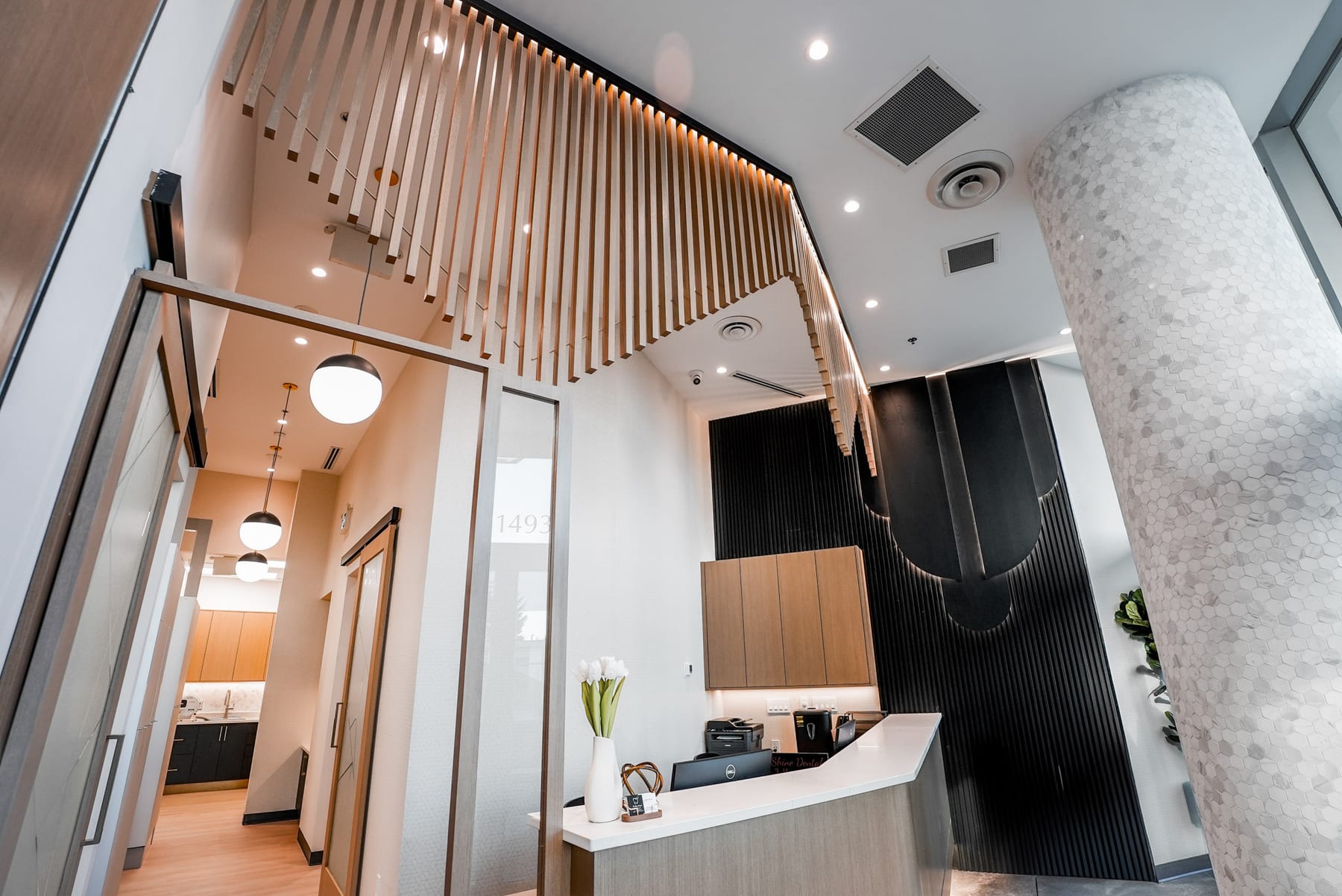
We have delivered two projects in Abbotsford: a dental clinic on Marshall Road and the Skinholic Aesthetics interior. Both are photographed on this site rather than described in the abstract, which is the standard we would want from anyone pitching us.
Chilliwack and the eastern valley are served from the same White Rock office, to the same standard. If you want the nearest comparable job to yours, ask and we will send the address.
For the municipal detail on either city, including the permit authority, the route and the citations for both, see the Abbotsford and Chilliwack city pages. If your project is a renovation rather than a new build, what permits you need for a commercial renovation in BC covers the approval order across the whole region.
Conclusion
The Fraser Valley is cheaper on trades and easier on access, and it is not simpler on process. Both cities run tenant improvements as their own permit category, Chilliwack triggers one on a change of occupancy alone, and only one of the two tells you how long review will take.
Plan the application route before the drawings are packaged, confirm the current window with the building department rather than from a previous job, and get the owner's authorization signed early. Do those three and the valley is exactly as straightforward as people expect it to be.
Frequently asked questions
Is a tenant improvement permit different in Abbotsford?
Yes. Abbotsford issues Tenant Improvement Permits as a distinct application type through Planning and Development Services, separate from the residential and complex-project streams. A package assembled as a general commercial application goes to the wrong queue, and the resubmission is the delay rather than the review itself.
How long does a commercial building permit take in Chilliwack?
Chilliwack is one of very few municipalities in the region that publishes a figure. Its own wording is that a permit for a new commercial, industrial, institutional or multi-family project can range from a minimum of 6 to 8 weeks to process, to upwards of more than 12 weeks from the date an application has been submitted, and that it moves with market demand. The city asks that current timing be confirmed with the Building Department at application.
Does a change of use need a permit in Chilliwack if no work is done?
Yes. Chilliwack triggers a tenant improvement permit on a change of occupancy type even where nothing is being altered physically. An office becoming a clinic is a permit application in its own right, and that is the step most incoming tenants have not budgeted time for.
Is commercial construction cheaper in the Fraser Valley?
Somewhat, and less than people assume. Trade rates run below Metro Vancouver and most sites have straightforward access and parking, which removes the access premium that pushes downtown Vancouver work to the top of the band. The published per-square-foot range for commercial construction stays the same across every city we work in, because the building does not get cheaper to build.
Do I need a letter from my landlord to apply in Chilliwack?
Yes. Chilliwack asks for a letter of authorization from the building owner alongside the drawings. A signed lease is not a substitute, and this is the single most common reason a tenant's application is incomplete on the first submission.
The service this article is about
Commercial spaces built around operations, access, finish quality, inspections, and business continuity.
Commercial Construction →Related reading
Planning a build like this?
Before you commit to a space, drawings, a budget, or a construction timeline, book a consultation and we will tell you what has to be planned before construction starts.